Acrylic vs. Polyurethane Waterproofing: An Expert’s Guide for Western Cape Homes
When it comes to protecting your home in the Helderberg region, waterproofing is not a luxury—it is an absolute necessity. The Western Cape’s unique climate, characterized by scorching summer sun and relentless winter downpours, puts extreme stress on your property’s exterior.
If you have started researching waterproofing solutions for your roof, balcony, or boundary walls, you have likely encountered the two most common options on the market: Acrylic and Polyurethane liquid waterproofing.
To the untrained eye, both look like thick paint in a bucket. However, chemically and structurally, they perform very differently. Choosing the wrong product for your specific application is a costly mistake that will lead to premature failure and water ingress.
As local waterproofing experts at RDB Home Solutions, here is our technical guide to understanding the differences and knowing exactly which system your home needs.
Understanding Acrylic Waterproofing
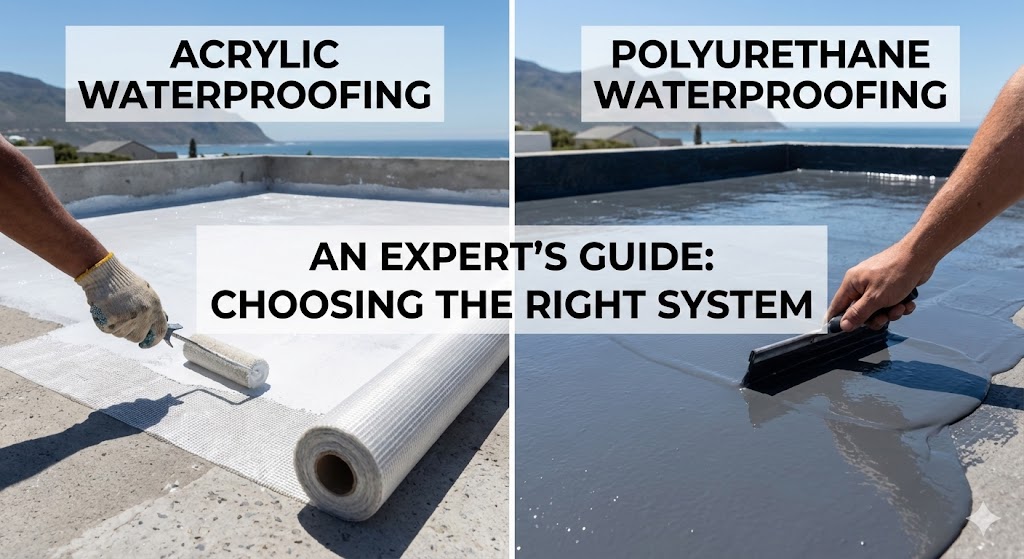
Acrylic waterproofing systems are water-based polymers. In South Africa, they are most commonly used in conjunction with a reinforcing polyester membrane (often referred to as a “membrane system”).
When applied, the liquid acrylic soaks into the membrane, curing to form a weather-resistant barrier.
The Advantages:
- Cost-Effective: Acrylic systems are generally more budget-friendly than polyurethane.
- UV Stability: High-quality acrylics are inherently UV stable, meaning they hold up exceptionally well to the harsh Somerset West summer sun without yellowing or chalking.
- Flexibility: They offer moderate flexibility to handle the natural thermal expansion and contraction of your roof.
- Color Matching: Because they are similar to paint, they are available in a wide variety of colors to match your home’s aesthetic.
The Limitations:
- Cannot Handle Standing Water: This is the critical weakness of acrylics. If water pools (or “ponds”) on an acrylic system for more than 48 hours, the product will re-emulsify (turn back to a liquid state), bubble, and peel away.
- Lifespan: While effective, acrylic systems generally require a maintenance topcoat every 3 to 5 years to remain watertight.
Where We Use It: Acrylic systems are excellent for areas with perfect water runoff. We regularly use them on pitched corrugated iron or IBR roofs, sealing tiled roof ridges, parapet walls, and exterior wall cracks.
Understanding Polyurethane Waterproofing
Polyurethane (PU) waterproofing represents the heavy-duty, commercial-grade side of liquid waterproofing. It is a synthetic resin that, once cured, forms a completely seamless, highly flexible, rubber-like membrane.
The Advantages:
- Handles Ponding Water Perfectly: Unlike acrylic, polyurethane does not re-emulsify in standing water. It acts like a custom-fitted rubber pool liner, making it impervious to pooling rain.
- Extreme Flexibility: PU can stretch significantly (up to 500% in some formulations) without tearing, making it ideal for large concrete slabs that experience major thermal movement.
- Seamless Application: Because it is applied as a liquid that cures into a single membrane, there are no joints or overlaps where water can sneak in.
- Durability: A properly applied polyurethane system has a much longer lifespan than acrylic, often lasting 10 to 15 years before requiring significant maintenance.
The Limitations:
- Higher Cost: The raw materials and precise application process make PU systems more expensive upfront.
- Moisture Sensitivity During Application: Polyurethane is incredibly sensitive to moisture before it cures. If applied to a damp concrete slab or if it rains before it sets, the product will blister and fail immediately.
- UV Degradation: Pure polyurethane is not UV stable and will degrade and turn chalky if left exposed to the sun. It almost always requires a specialized aliphatic (UV-stable) topcoat.
Where We Use It: Polyurethane is our go-to solution for high-risk, flat surfaces. We strictly use it for flat concrete roofs in Strand and Gordon’s Bay, tiled balconies, retaining walls, and internal box gutters where standing water is inevitable.
The Verdict: Which System Does Your Home Need?
The rule of thumb we use at RDB Home Solutions is simple: Slope dictates the system.
If the surface has a steep pitch and water runs off immediately, a high-quality reinforced Acrylic system is usually the most cost-effective and appropriate choice.
If the surface is flat, prone to pooling water, or sits beneath soil (like a retaining wall), Polyurethane is the only reliable, long-term solution.
Applying acrylic to a flat concrete roof is the number one cause of waterproofing failure we are called out to fix in the Helderberg area. It might look fine for the first dry month, but the first heavy winter storm will destroy it.
Get Expert Waterproofing Advice in the Helderberg
Don’t guess when it comes to protecting your biggest asset. Waterproofing is a highly technical trade, and the success of the project relies entirely on selecting the right chemistry for the environment.
Contact RDB Home Solutions today. We will conduct a thorough site inspection and recommend the exact waterproofing system your Somerset West, Stellenbosch, or Helderberg home requires.
About the Author: Dylan Schuttler Dylan Schuttler is the founder of RDB Home Solutions. With over 10 years of hands-on experience in residential construction, painting, and waterproofing in the Western Cape, Dylan specializes in practical, long-lasting building solutions tailored to the Helderberg climate. RDB Home Solutions is dedicated to delivering reliable workmanship, clear communication, and on-site accountability for every project.