
The Helderberg Wind Factor: Best Outdoor Entertainment Designs for Gordon’s Bay
Living in Gordon’s Bay offers a lifestyle few can match. Whether you are perched on Mountainside with a panoramic view of the coastline, enjoying the waterfront living of Harbour Island, or tucked away in Suikerbossie, the proximity to the ocean and the dramatic Hottentots Holland mountains is breathtaking.
However, there is a legendary local resident that every homeowner must contend with: The South-Easter.
In the Helderberg Basin, the wind isn’t just a weather report; it is an architectural constraint. The South-Easter—locally known as the “Cape Doctor”—accelerates down the steep mountain faces and hits Gordon’s Bay with a unique, funnelled force. Too many homeowners have invested fortunes in beautiful patios only to find them unusable for six months of the year because the wind is too fierce to light a braai, hold a napkin down, or even have a conversation.
At RDB Home Solutions, we view the wind as a design challenge to be solved, not an inconvenience to be accepted. To truly enjoy wind-sheltered outdoor living in Gordon’s Bay, you need a design that engineers the wind out while keeping the views in.
1. Understanding the ‘Wind-Tunnel’ Effect
The geography of Gordon’s Bay creates a micro-climate unlike the rest of False Bay. When the South-Easter blows across the ocean, it rises over the Hottentots Holland range and then drops vertically down the sheer cliffs behind the town, gaining massive velocity.
In Mountainside, the wind hits houses from above and behind. In Harbour Island, it blasts across the water. A successful Gordon’s Bay patio design must account for these specific ‘Wind Dynamics.’ Standard umbrellas or light awnings are useless here. You need permanent, engineered solutions.
2. Strategic Structural Wind-Breaks: Deflection, Not Obstruction
The core principle of wind-proofing is not to try and “stop” the wind—the wind always wins. The goal is to redirect or diffuse it.
Louvered Pergolas: The Adaptable Shield
A permanent, motorised louvered pergola (often constructed of coastal-grade aluminium) is one of the most effective tools in the Helderberg. By adjusting the angle of the roof louvers, you can create an upward air pressure that “lifts” the prevailing wind over the patio space, creating a calm “bubble” beneath. Crucially, these systems have integrated guttering to handle the mist and light rain that often accompany the wind.
Feature Walls and Glass ‘Screens’
Solid architectural walls made of plastered brick or local stone can be built strategically to act as “impact zones” that break the wind’s initial force. However, if you are on Mountainside, you don’t want to block your view.
This is where permanent glass wind screens come into play. These are thick, toughened safety glass panels on minimal stainless steel fittings. They allow you to maintain your seamless False Bay view while providing a solid barrier against gusts that would otherwise scour your deck.
3. The Frameless Glass Revolution: Reclaiming the View Year-Round
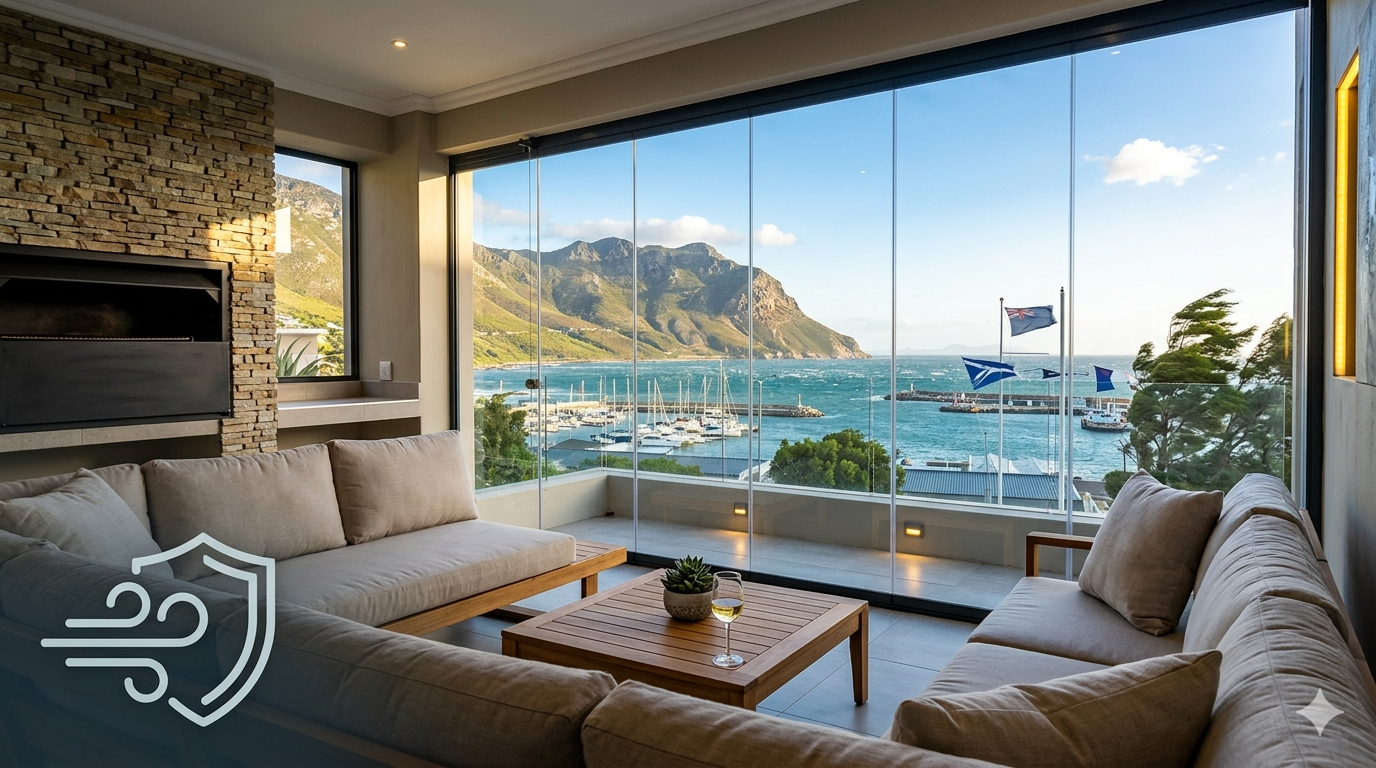
The definitive solution for modern Helderberg homes is the frameless glass enclosure, also known as “glass curtains.” This takes a standard patio or balcony and encloses it entirely with sliding or stackable glass panels.
The Best of Both Worlds
When the weather is perfect, the panels stack neatly away, giving you a completely open outdoor experience. When the South-Easter hits, you slide the panels shut in minutes. Your patio transforms into a wind-proof, sound-proof “sunroom” that retains the sensation of being outdoors without the exposure.
Technical Engineering Requirements
You cannot simply install generic glass curtains in Gordon’s Bay. At RDB Home Solutions, we insist on:
- Specific ‘Wind-Load’ Calculations: The glass thickness (usually 10mm or 12mm) and track strength must be engineered to withstand the specific pressure coefficients of your property’s altitude and exposure.
- Marine-Grade Hardware: Given the “Strand Salt” context discussed previously, every hinge, track, and handle must be Grade 316 stainless steel or anodized aluminium. Generic parts will seize up and rust within a single season.
4. Engineering the Ultimate Wind-Protected Braai Area
A Helderberg braai area renovation requires specialized knowledge. A standard fireplace built in Gordon’s Bay often suffers from “smoke-back,” where the wind forces smoke down the chimney and into the patio or house.
Smoke-Back Solutions
The key is chimney design. We construct chimneys with specialized ‘H-type’ or motorised rotational cowls that utilize the wind itself to create suction, actively pulling smoke up the flue, regardless of the wind’s direction.
Wind-Protected Cooking
The braai unit itself should be slightly recessed within a protected “alcove.” If you are building an outdoor kitchen, avoid light timber cabinetry. We utilize polished concrete or heavy granite countertops, which are durable, easy to clean, and will not warp or bleach in the extreme conditions.
5. The “Soft” Approach: Landscaping as a Wind Buffer
For properties on larger plots, such as in parts of Somerset West prone to the wind (like Spanish Farm), soft landscaping is a valuable secondary defence. Instead of a solid hedge that the wind can push over, we recommend a diffuse barrier of indigenous, wind-hardy plants.
Species like Leucadendron (Cone Bushes) or Olea europaea subsp. africana (Wild Olive) have flexible branches and dense, tough leaves. They absorb the wind’s kinetic energy and diffuse its force, reducing the velocity that reaches your patio.
Case Study: Reclaiming a Mountainside Patio
A client in Mountainside, Gordon’s Bay, had a multi-level deck they were unable to use between October and March. The South-Easter made it physically unpleasant to sit outside.
RDB’s Solution:
- Level 1 (Lower): Installed a high-performance motorised louvered pergola to redirect overhead gusts.
- Level 2 (Upper): Fully enclosed the upper balcony area with 12mm toughened frameless glass stack doors.
- The Result: The client gained a 20sqm year-round lounge with uninterrupted views, increasing both the usable square footage and the resale value of the home.
Side-by-Side: Glass Curtains vs. Polycarbonate Shutters
A common debate for architectural wind solutions is choosing between glass and aluminium/polycarbonate shutters.
| Feature | Frameless Glass Enclosures | Adjustable Polycarbonate Shutters |
|---|---|---|
| Wind Protection | Excellent (completely sealed). | Good (adjustable flow, slight gaps). |
| View Preservation | Optimal (invisible lines). | Moderate (slats create vertical grid). |
| Light Control | Natural (no shading). | Excellent (can darken the space). |
| Heat Retention | High (creates green-house effect in winter). | Low (allows airflow). |
| Maintenance | Requires regular cleaning (salt residue). | Low (occasional rinsing). |
The RDB Advantage: Micro-Climate Engineering
At RDB Home Solutions, we aren’t general contractors; we are Helderberg specialists. We don’t just “install a product”—we engineer a solution for your specific site conditions.
- ECSA Sign-off: For complex glass enclosures or large pergolas, we provide professional engineering sign-off on the wind-load calculations, protecting your insurance and your family.
- Integrated Renovation: We bridge the gap between architectural wind-breaking and luxury finishes, ensuring the final product looks like a seamless extension of your home, not a clumsy add-on.
Don’t Let the Wind Win
Is your patio a sanctuary or a standard-issue wind tunnel?
Contact RDB Home Solutions today to schedule a ‘Wind-Dynamics Patio Consultation.’ Let us help you engineer an outdoor living space that lets you enjoy the best of Gordon’s Bay, 365 days a year.


