From Orchard to Home: High-Performance Insulation & Heating for Grabouw Winters
The Elgin Valley is famous for its cool-climate wines and crisp apples, but for those who call Grabouw home, that same “crispness” takes on a different meaning in July. Unlike the coastal Mediterranean climate of Cape Town or the temperate suburbs of the Helderberg, Grabouw experiences “Mountain Cold.”
Situated at a higher elevation on the Overberg fringe, Grabouw homes face high-altitude humidity, frequent mountain mist, and winter temperatures that regularly dip toward freezing. In this environment, a standard house becomes a “walk-in fridge” if it lacks a technically sound thermal strategy.
At RDB Home Solutions, we don’t just “build” in the Elgin Valley; we engineer for it. True winter-proofing is about more than just a fireplace—it is about creating a high-performance Thermal Envelope that keeps the heat in and the damp out.
1. The Thermal Envelope: Beyond “Standard” Insulation
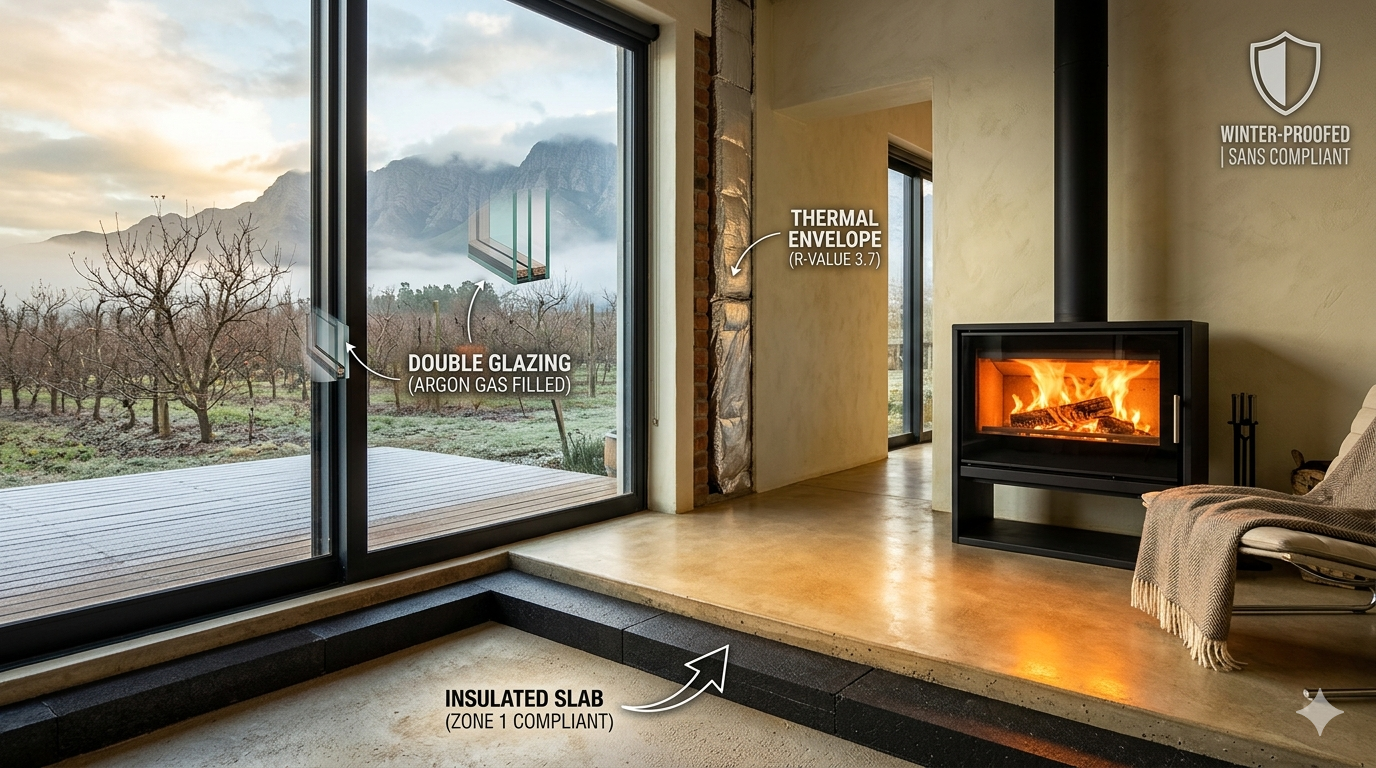
In South Africa, Grabouw falls into Climate Zone 1 (Cold Interior). Under the SANS 10400-XA 2026 energy regulations, homes in this zone must meet the highest R-value (thermal resistance) requirements in the country.
Ceiling Insulation: The Primary Defense
Heat rises, and in a typical uninsulated home, up to 40% of your warmth escapes through the roof. For Grabouw, we move beyond basic reflective foils. We specify high-density bulk insulation (like mineral wool or cellulose fibre) with a minimum total R-value of 3.7 to 3.9. This creates a thick “blanket” that resists the biting mountain air.
Floor Insulation: Stopping the “Thermal Bridge”
One of the most overlooked aspects of rural construction is floor insulation. In the cold Elgin soil, a concrete slab acts as a “thermal bridge,” sucking heat directly out of your living space.
- The Solution: We install high-compressive-strength EPS (Expanded Polystyrene) or IsoBoard directly beneath the floor slab or screed. This decouples your home from the frozen ground, making underfloor heating significantly more efficient.
Wall Cavities and Moisture Resistance
In high-humidity areas, standard glass-wool batting can become damp, losing its insulation properties and encouraging mold. We utilize moisture-resistant batting or rigid PIR boards within wall cavities to ensure the thermal barrier remains effective even during the wettest Overberg winters.
2. The Glazing Strategy: Eliminating the “Cold Spot”
In a well-insulated home, the windows are often the weakest link. In Grabouw, single-pane glass isn’t just an energy drain; it’s a source of constant condensation and mold growth.
Double Glazing is Non-Negotiable
Double glazing creates an insulating layer of air (or argon gas) between two panes of glass. This prevents the internal pane from reaching the “dew point,” which stops condensation from forming.
Thermal-Break Frames
Standard aluminium is an excellent conductor of cold. To be truly effective, we specify Thermal-Break Aluminium frames. these frames feature a reinforced polyamide strip between the inside and outside aluminium profiles, “breaking” the path for the cold to enter your home.
3. Advanced Heating: Efficiency Meets Luxury
Once your “Envelope” is sealed, you need a heat source that is as efficient as it is aesthetic.
- Closed-Combustion Stoves: Unlike open hearths (which lose 80% of their heat up the chimney), closed-combustion stoves from brands like Morsø, Canature, or Dovre operate at 80% efficiency. They provide a deep, dry heat that is perfect for the Elgin climate.
- Hydronic Underfloor Heating: For large farmhouses, we install water-based (hydronic) systems. These circulate warm water through pipes in the floor, powered by a heat pump or a pellet boiler. It is the gold standard for consistent, “barefoot” warmth.
- Inverter AC Units: Modern “A-rated” inverter units are highly efficient for maintaining a baseline temperature and have the added benefit of dehumidifying the air during the damp months.
4. Moisture Management: The Damp Factor
A highly insulated home can become too airtight, leading to “Sick Building Syndrome” where moisture from cooking, breathing, and showering gets trapped. In Grabouw, this leads to damp walls.
We integrate Mechanical Ventilation with Heat Recovery (MVHR) or high-spec extraction systems. These units replace stale, damp air with fresh, filtered air while “harvesting” the heat from the outgoing air, ensuring your home stays dry without losing your expensive warmth.
The RDB Advantage: Building for the Overberg Fringe
At RDB Home Solutions, we view thermal hygiene as a technical priority, not an optional extra.
- SANS 10400-XA Compliance: We ensure every renovation or new build in Grabouw meets or exceeds 2026 energy codes.
- Thermal Imaging: We use infrared thermography to “stress test” our builds, ensuring there are no gaps in your insulation.
- Local Logistics: We understand the Elgin Valley’s specific supply chain, ensuring specialized materials are on-site when needed.
Winter-Proofing Audit & ROI Table
| Heating Source | Efficiency | Approx. Running Cost (2026) | Property Value Impact |
|---|---|---|---|
| Open Fireplace | 15–20% | High (Wood hungry) | Neutral / Aesthetic |
| Closed-Combustion | 75–85% | Medium (Efficient wood) | High |
| Electric Underfloor | 95%+ | High (Electricity) | Medium |
| Hydronic (Heat Pump) | 300–400%* | Low | Very High |
| *Coefficient of Performance (COP): 1 unit of electricity produces 3-4 units of heat. |
Don’t Spend Another Winter in the Cold
Is your Grabouw home a sanctuary or a “walk-in fridge”? The transition from “Orchard to Home” requires a technical partner who understands the science of warmth.
Contact RDB Home Solutions today to schedule a ‘Thermal Efficiency Audit’ of your property. Beat the 2026 winter and invest in a home that is as warm as it is beautiful.
Keywords: Grabouw heating solutions, insulation contractors Overberg, double glazing Elgin, closed combustion fireplaces South Africa, energy efficient homes Grabouw, SANS 10400-XA Zone 1, Elgin valley home maintenance.